Welcome to Putingrad
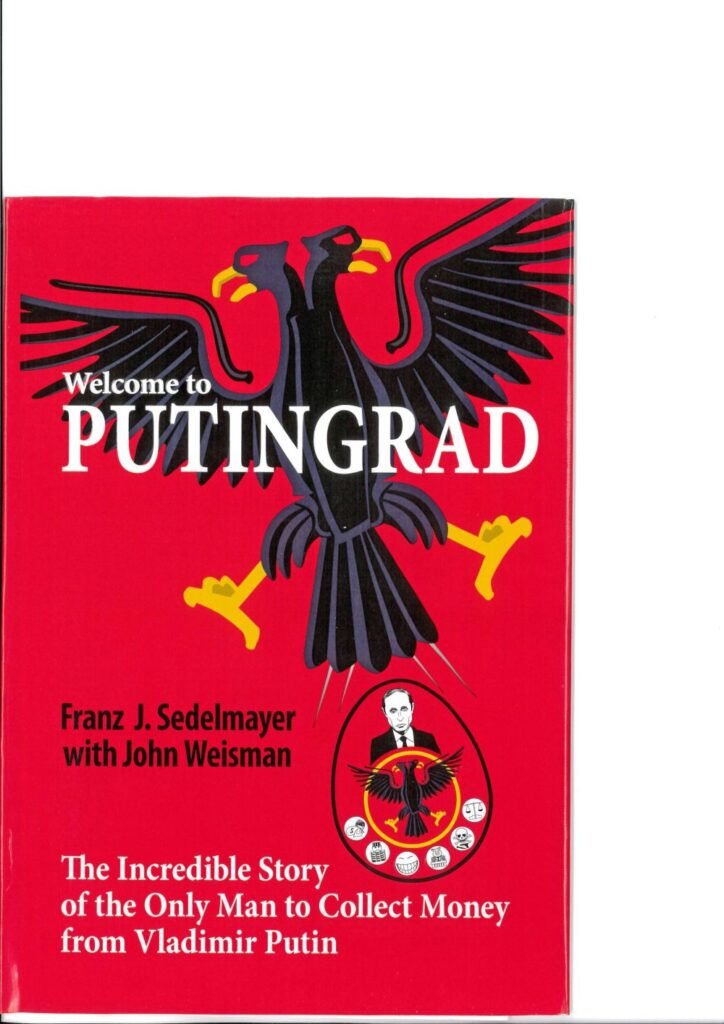
Russia is a thoroughly corrupt state. Many companies that invested in the country have had to learn this from experience. Most were subsequently expropriated or robbed. So far, only one entrepreneur has managed to get his investment back. His story is an example of how the Putin system functions and of the weakness of the West.
Franz Sedelmayer first came to Leningrad during the Soviet era. Today, the city is once again called St. Petersburg. He built up a company there. He did good business, had around 500 employees in his company, and was expropriated in 1996. The company operated in the security sector. Sedelmayer brought modern equipment to the then completely dilapidated USSR and trained special police units.
In St. Petersburg, he dealt with, among others, a man who is today charged with war crimes by the War Crimes Tribunal: Vladimir Putin. At the time, he was the right-hand man of the Mayor of St. Petersburg, Sobchak. Putin was responsible for foreign investment, though his most important task was to protect the corrupt mayor. As Franz Sedelmayer recounted at an event of the Paneuropa Movement in Vienna, Putin had a certain sympathy for Germans. However, he was cold, indifferent, and, as a trained KGB man, possessed the ability to present himself to others exactly as they expected.
Franz Sedelmayer’s company was a US firm. As a German, he had the right to an arbitration claim following his expropriation by presidential decree. This claim was successful. However, the Russians refused to pay. He therefore had to search for Russian assets abroad. Due to pervasive corruption, much of Russia’s state revenue ended up in private hands. This included, for example, the fees for overflight rights that foreign airlines had to pay for flights over Russian territory.
A 15-year battle for compensation
Sedelmayer therefore tried to obtain an enforceable title for such payments. He failed in this regard. He eventually found success with Russian real estate abroad. Fifteen years after the expropriation, he had his money back. To date, he is the only person to have received compensation, despite numerous ongoing proceedings. Ukrainian companies also have claims for compensation from Russia, but the country does not pay.
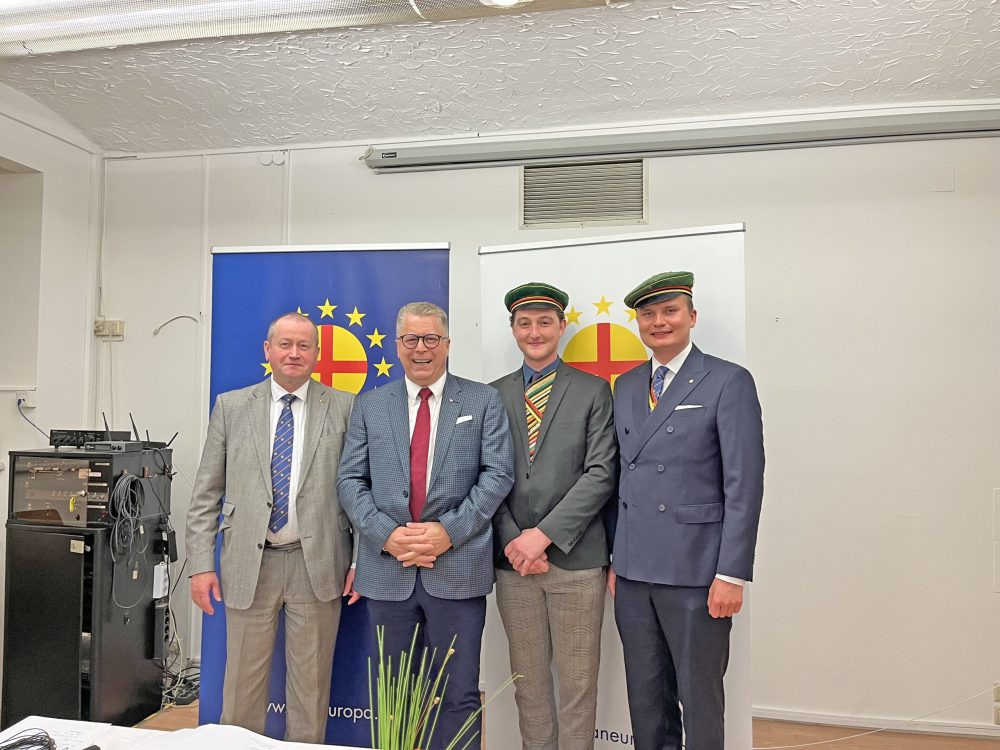
The speaker Franz Sedelmayer (with red tie) with representatives of the inviting organisations. To the right of Sedelmayer are the Senior of KÖL-Maximiliana, Martin Johannes Gruber, and Maximilian Schmid, President of Paneuropa Youth and also a member of Maximiliana. On the far left, Rainhard Kloucek, President of the Paneuropa Movement Austria.
For Franz Sedelmayer, the difficulties in obtaining compensation lay not only in Russia’s corrupt system but also in the political weakness of the West. He told the adventurous story of how the German state obstructed him when he tried to seize Russian assets at an aviation fair in Germany. Allegedly, according to the court, the German authorities could not find any assets.
The court instructs to find nothing
The bailiff stated that he could find nothing on the instructions of the court. However, he did eventually find something. Nevertheless, Franz Sedelmayer, along with his father of the same name (who was held even longer than he was) and a team of journalists who wanted to document the story, were simply detained. After his brief release (the arrest was illegal anyway), he was detained again at the aviation fair.
Western weakness towards Russia
The German state had spent six weeks preparing to prevent the enforcement. Telephones were tapped for this purpose without a judicial warrant. A State Secretary from the Federal Chancellery had called him to dissuade him from the enforcement, claiming it could lead to war. The story is an example of political weakness towards Russia. The full details of this story can be read in the book ‘Welcome to Putingrad’, published in 2017, which Franz Sedelmayer wrote together with John Weisman.
The event with Franz Sedelmayer, titled ‘Russia’s Steady March into Totalitarianism’ and co-hosted by organisations such as the KÖL Maximiliana student fraternity and the VLÖ, was not just about the story of the expropriated company, but primarily about the current situation in Russia’s war against Ukraine, which began with the annexation of Crimea in 2014.
The situation is an example of the political weakness of the West. According to Franz Sedelmayer, it has still not been possible to agree on a definition for the goal of the war. The West is not acting in unison. Individual states continue to pursue their own inter-
ests. Seventy per cent of capital investments from the West are still active in Russia. However, in the recent past, numerous Western investors who thought they would be safe if they stayed have once again been summarily expropriated.
A Cold War-style embargo is needed
Russia is still able to obtain everything it needs. The sanctions are too weak. Above all, they are easy to circumvent. Statistics on the development of trade relations between Russia and third countries, and between these third countries and Western nations, clearly show how sanctions are being bypassed. In this context, Sedelmayer recalls the Cold War, during which there were not just sanctions but an embargo that also applied to third parties. This means that a company from another country doing business with the embargoed nation would no longer have the chance to operate in the country that had joined the embargo.
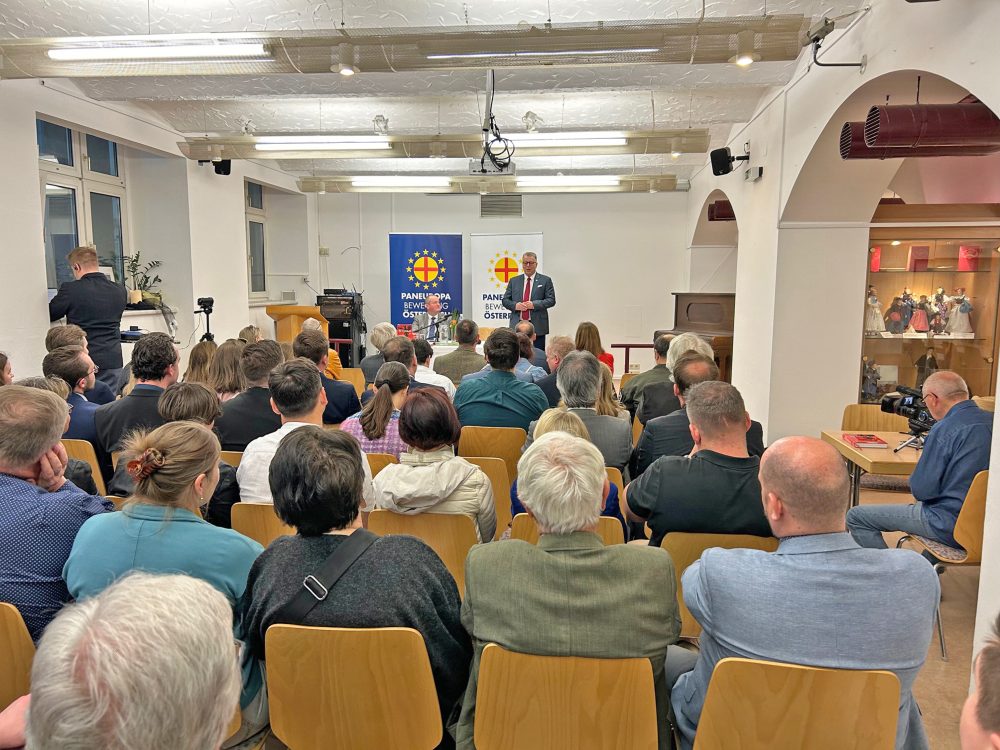
A packed hall during Franz Sedelmayer’s lecture. On the left of the picture (standing with his back to the viewer) is Franz Sedelmayer Jr., who organised the live stream.
For Franz Sedelmayer, the fact that Putin dared to launch a full-scale invasion of Ukraine is partly due to the successful tests he completed. The 2008 war against Georgia had no consequences. Angela Merkel and Nicolas Sarkozy, the German Chancellor and the French President, had begged Putin for peace as mediators. In the 2014 invasion of Crimea, Putin was concerned with access to the sea. However, he would not have needed a war for this, as access to the sea was secured by treaties. The annexation of Crimea and the invasion of the Donbas also remained without consequences.
Europe must learn to show strength
Europe and the Western world were unable to show strength. A common line was missing. For Putin, the war is also a way to secure his domestic power base. Franz Sedelmayer, who was once acquainted with Putin in St. Petersburg, does not share the assumption that Putin could be ousted in the event of a defeat. In his assessment, he will remain in power as long as he is healthy. This is partly because there is no opposition in Russia. According to a cautious estimate by the expropriated entrepreneur, perhaps three per cent of the population could be considered part of an opposition. For the remaining 97 per cent, collective memory dictates their passive behaviour. For generations, Russians have learned that criticism of the system can very quickly end fatally. Adaptation is a form of self-protection and protection for the family.
Russia cannot develop a free system
The clear assessment is that Russia cannot develop a free system of its own accord. Such a system has never existed in Russia. It is also obvious that the war in Ukraine is not going as Putin expected for Moscow. This is a result of massive corruption in the army. For instance, units were feigned that did not exist at all. This allowed officers to pocket funds for troops that were not there. The non-commissioned officers in the old Soviet army usually came from Ukraine. On the battlefield, NCOs are crucial for leading combat troops. The Russian army lacked these NCOs. However, Moscow has learned from the experiences of the past two years and has begun some reforms.
Franz Sedelmayer does not share dreams of the quickest possible peace. Should the war end temporarily with territorial gains for Russia (i.e., a Russian victory), it would not be peace. Within a short time, Putin would start the next war, which would then likely directly affect a NATO country.
