Security through Unity
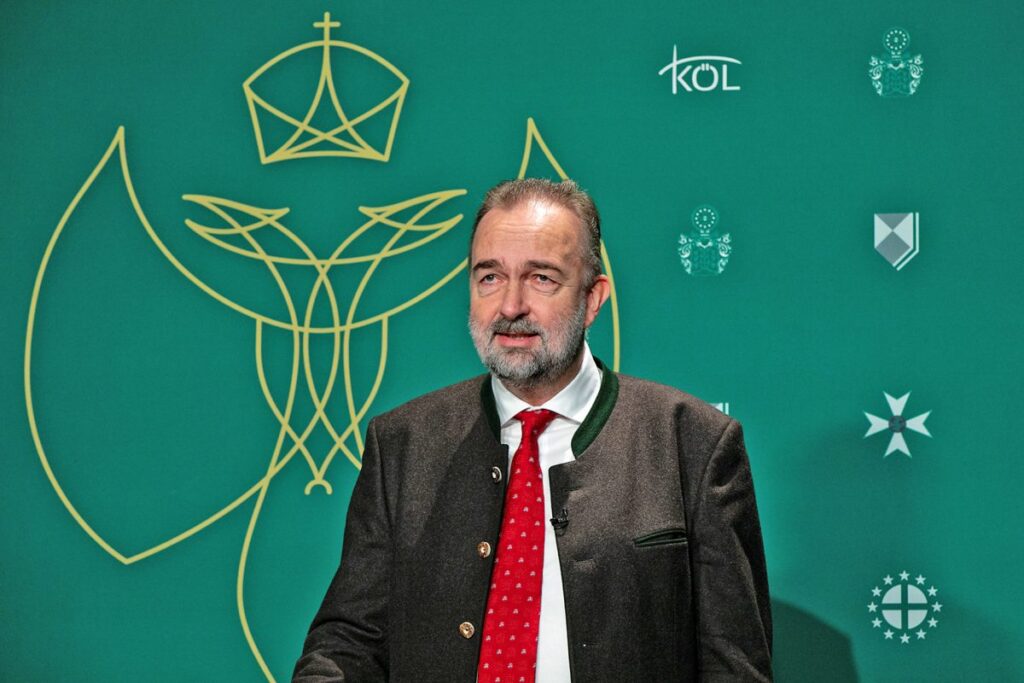
In his “Speech on the Future of Europe”, Karl von Habsburg, President of the Paneuropa Movement Austria, advocates for stronger military support for Ukraine, calls for a regime change in Moscow and Minsk, addresses China’s power politics which pose a threat to the Western community of values, and demands a European foreign and security policy.
Ladies and Gentlemen,
Allow me to begin this speech with a quote from my address exactly one year ago:
“The aim of this ‘Speech on the Future of Europe’, which I will deliver every year on 11th January, is to address European policy issues both fundamentally and by discussing current challenges. And, concrete political ideas for shaping European policy should always be put forward, the implementation of which we must continue to work on.” End of quote.
European unification – as Minister for Europe Edtstadler mentioned in her speech – is a success story, but it will only be perceived as such if we can offer solutions to the challenges of our time.
The current challenge is Russia’s war of annihilation against Ukraine. However, this should not obscure our view of China’s geopolitical ambitions. This speech will focus on Moscow and Beijing. Europe’s weakness and the necessary consequences for European policy form the second pillar of this address.
The world and its order, and specifically the European order, is no longer what it was a year ago, and what we all relied upon. As early as 2014, Russian President Vladimir Putin launched a war of aggression against Ukraine. In a swift move, the Crimean Peninsula was seized and annexed. The fact that there was betrayal by generals on the Ukrainian side does not make this attack any better. Subsequently, there was an attack on Eastern Ukraine, which was still very skilfully conducted below the level of a full-scale invasion, and reached its bloodiest climax to date with the downing of flight MH17.
A year ago, this attack was still the frozen conflict brought about by the 2014 ceasefire, which European countries had also helped negotiate. However, Russia had already positioned its army on Ukraine’s borders, and had also used Belarus, with Alexander Lukashenko’s terror regime, as a staging ground for an attack. In January 2022, a high-level meeting took place between the USA and Russia concerning the situation in Ukraine. Europe, the EU, was not involved in this meeting. Analysts at the time referred to Ukraine as a buffer state. That is, a buffer between Europe and Russia. A choice of words reminiscent of the term “Zwischeneuropa” (Interwar Europe) from the period between the First and Second World Wars.
Russia assured at the time that it had no plans for war. You will recall the images of the large, long table where Vladimir Putin sat on one side, and his respective European interlocutor on the other, whom Putin assured that there would be no war.
The European interlocutors wanted to believe this assurance. After the fall of the Iron Curtain at the Pan-European Picnic on 19th August 1989, after the dissolution of the Warsaw Pact and the end of the Soviet Union, both in 1991, Europe banked on the end of wars in Europe. The illusion of eternal peace emerged. Military capabilities, and with them many capacities for disaster relief, were drastically cut. The peace dividend was cashed in, the money channelled into welfare state redistribution programmes. One could also speak of buying votes.
At the same time, international treaties were supposed to ensure that a new era of peace would secure prosperity forever. The USSR itself signed the CSCE Final Act, which already enshrined the non-alignment of sovereign states. At the end of 1990, the “Charter of Paris for a New Europe” followed, in which this non-alignment – and this was already after the dissolution of the Warsaw Pact – was reaffirmed. The relationship between Moscow and Kyiv was regulated by the Budapest Memorandum of December 1994. A treaty which, beyond its bilateral scope, also had massive significance for containing the nuclear threat. For the guarantee of its borders by the guarantor powers, i.e., the nuclear powers Russia, USA, and Great Britain, nuclear power Ukraine renounced its nuclear weapons.
All these treaties, and several others, were supposed to make war in Europe impossible. But reality does not always adhere to treaties. And practically with the overcoming of the Iron Curtain came the first wake-up call not to sacrifice Europe’s defence capability to an illusion of eternal peace – I ask you here not to confuse hope with illusion. In former Yugoslavia, the Serbian dictator Slobodan Milosevic began his wars for a Greater Serbia, which brought immeasurable suffering to the region for almost ten years. The bloodthirsty chants of the Chetniks in Vukovar must remain in our memory, as must the Srebrenica massacre or the attempt to annihilate the Kosovars. This killing was ultimately ended by targeted NATO military strikes, led by the USA.
In Europe, however, those security experts who advocated for a reduction in – naturally costly – military capabilities continued to thrive, arguing that there would be a warning period of about ten years for larger conflicts. The ‘little green men’ in Crimea did not adhere to this warning period, and had already brought the peninsula under their control before these experts could even consider how to respond to the new challenges to European security.
And even in 2014, after Russia’s attack on Georgia in 2008 and then Ukraine in 2014, Europe still did not want to draw conclusions from this situation. Putin continued to be courted here. Instead of developing new concepts for dealing with a threat from Moscow, dependence on Russian gas increased. Concepts for diversifying suppliers were politically overturned at the highest level. Austria and Germany were particularly susceptible to the temptations of cheap gas from Russia. This allowed them to convince themselves that the transition to so-called alternative energy sources would proceed without any problems. Former government representatives from many European countries had no qualms about being on the payroll of Russian companies and lobbying for Russian interests.
You will forgive me, Ladies and Gentlemen, for having taken such a long look back, especially at a development that began in 1989 with a shining moment for humanity, but which has now brought us into an extremely dangerous global political situation. So far, I have focused only on Europe, and have not even touched upon the brutal wars in Africa, or the many other hotbeds of conflict in the world, or the brutal suppression of the freedom movement by the regime in Iran. It would also exceed the scope of this speech to address all these challenges.
We cannot turn back the clock. We can only draw the right conclusions from the given situation, and the events that led to it, in order to be prepared for future challenges.
Just as there are criminals in every society at all times, so too are there these criminals in the society of states at all times. The old saying, “si vis pacem para bellum”, i.e., “if you want peace, prepare for war”, unfortunately still holds true, and will continue to do so. Nothing is more dangerous than being rich and weak, and Europe is still precisely in that situation. Although the wealth itself is also dwindling. The redistributive welfare state simply does not create wealth; it merely redistributes it. Prosperity is created through innovation and investment. Both, however, require appropriate framework conditions. If one forgets this principle and succumbs to the temptations of bureaucracy, then innovative forces will migrate, and investments will seek regions with better conditions.
But let us stay with the geopolitical situation, which today is also no longer what it was 30 years ago with the collapse of the Eastern Bloc. At that time, the Western system of the USA and free Europe stood on one side, and the Eastern Bloc system, led by the Soviet Union as the second superpower, on the other. The West clearly won the Cold War. The offer of freedom, democracy, and a free economy was so tempting that practically all countries of the former socialist world in Europe sought accession to NATO and the EU. This offer remains so attractive that the countries of Southeast Europe, as well as Ukraine and Georgia, want to join precisely these alliances.
Although Russia lost its status as a superpower, it was still militarily strong enough to interfere in various wars, or even intervene decisively. This was and remains the case in the tense relationship between Armenia and Azerbaijan, but it also showed itself in the Middle East, in the Syrian war. Putin bombed his way back onto the stage of world politics with his military intervention in favour of Assad. Without him, there was no chance of a peaceful solution in the region. He could have enjoyed this position and would probably be a welcome interlocutor today for both the USA and the Europeans and other countries around the world. And he could have continued to earn a lot of money from the sale of gas and other raw materials. Money that Russia so urgently needs to create civilised conditions even outside the major cities.
His dream of founding a new Russian empire – a kind of mixture of the Soviet empire and the old Tsarist empire – has now brought him into a situation from which he will probably be remembered in history books as one of the great war criminals.
Many wanted to believe that Putin acted, firstly, rationally and, secondly, well-informed. Both assumptions have proven false. If he genuinely believed he could take Kyiv in a swift move, eliminate the president there, establish a puppet regime, and then control Ukraine, then he fell victim to misinformation about the actual situation in his neighbouring country, meaning he was not well-informed. And if he were to act rationally, he would have continued to rely on good trade relations with Europe and the rest of the world. Firstly, he could have earned significantly more money that way than is possible with the war; secondly, he could have exerted considerably more influence on world politics.
The Russian war of annihilation against Ukraine has the potential to last well into this year or longer. We must also factor into our scenarios a renewed invasion via Belarus towards Kyiv, and thus new refugee flows into EU countries. But no matter how long the war lasts, Russia will have lost its status as a world power afterwards. China, Russia’s old rival in Asia, will benefit from this. For the Chinese leadership, Russia is already considered merely a junior partner. China has long since overtaken Russia and is nowadays just as much one of the great threats to the system of freedom, democracy, rule of law, and free economy that the West generally stands for.
However, we must be clear that this Russian war against Ukraine is not just an attack on Ukraine. It is an attack on Europe, on our way of life, on democracy, freedom, human rights, the rule of law, and the market economy. It is a war that Eastern despotism has unleashed against Western democracy. Putin despises the European way of life. Despite all the criticism that we occasionally level at European policy: no European can have an interest in submitting to Putin’s despotism. Even the wealthy Russians who send their children to schools and universities in the West do not want that.
And because we cannot have an interest in submitting to the despotism of the war criminal Vladimir Putin, we must also be clear that this war must only end with a victory for Ukraine and a defeat for Russia. This is not about, as is occasionally heard from high political circles in Western Europe, having to consider Russian security interests and offering Putin a face-saving exit from the war. No one has violated Russia’s security interests. There was no stationing of nuclear weapons in Russia’s neighbourhood, as was the case with the Cuban Missile Crisis on the border with the USA. No one attacked Russia. With the war crimes committed so far, Putin has lost every right to save face. He belongs before a war crimes tribunal, along with his accomplices, and there must be a regime change in Moscow.
And in Minsk, by the way, too.
Naturally, Russia will have to pay reparations. Therefore, the West should immediately confiscate the approximately 300 billion dollars in currency reserves held by the Russian Central Bank in seven Western central banks. This money will be necessary for the reconstruction of Ukraine. It would be negligent not to do so. Similarly, the legal prerequisites must be created to use all frozen assets of Russian oligarchs of the Putin system for reparations.
I also dismiss those historical comparisons which argue that Russia should not be humiliated, just as Germany should not have been humiliated in the Treaty of Versailles, that the reparations were too high and thus led to Hitler and the Second World War.
It is true that the Second World War was a consequence of Western weakness towards Hitler. There were practically no consequences for Germany’s occupation of the Rhineland. And the reaction to the occupation of the Sudetenland was not the necessary military response of the Allies, but a conference in which Hitler’s previous conquests – which included Austria – were accepted.
All those who speculate that Putin and his regime could be appeased by ceding Crimea, Eastern Ukraine, and Southern Ukraine should consider the consequences. If we want to learn from history, then we can only conclude that we must support Ukraine so massively – and by that I mean primarily with military equipment and intelligence – that it can push Russia back to the borders guaranteed in the Budapest Memorandum.
Of course, this could lead to the destabilisation of Russia. But let us consider: Russia is a colonial empire. Colonial empires disintegrate. This also applies to Russia. It is always a question of how long the colonised peoples will tolerate the rule. Currently, the minority peoples in the Russian colonial empire primarily serve as cannon fodder for the Russian army. This is not a satisfactory situation for these peoples in the long run. We must anticipate scenarios that mean a – probably very turbulent – end to the Russian empire.
Japan and Germany surrendered unconditionally at the end of the Second World War. After this surrender, both countries embarked on a path that brought them democracy, the rule of law, and economic prosperity. We should therefore not fear a military defeat of Russia, but rather see it as an opportunity for democracy, the rule of law, and a free economy to emerge in that country too.
Excellencies, Ladies and Gentlemen!
Let us return once more to the power that we must not lose sight of amidst all geopolitical developments: China.
China thinks long-term. In 2049, the country will celebrate 100 years since the founding of the People’s Republic of China. This is a date we must keep in mind when dealing with Chinese policy. For Beijing’s clear goal is to have fully integrated Taiwan into China by then. This also tells us something about the possible timeframe if China wishes to achieve this goal militarily. Because full integration means that both the war and the reconstruction must be over and done with by then.
China is massively rearming militarily. This can best be seen in its navy, and by comparing it with the USA. The USA has seven military shipyards; the People’s Republic of China has 19 large military shipyards. The Jiangnan Dao shipyard on the Yangtze River alone has a greater capacity than all seven US shipyards combined. China now has the largest navy in the world. For China, the South China Sea is what the Caribbean is for the USA.
As early as 2013, President Xi Jinping launched the “New Silk Road” project, a large-scale economic and foreign policy prestige project. The clear goal of this Silk Road strategy is to create an economic area dominated by China, in which Eurasian and African states are closely connected by land and sea. Numerous countries around the world have already participated in this century-long project. In addition, Beijing has established further economic and financial institutions that serve as important instruments for the communist leadership for geopolitical purposes.
At the same time, the totalitarian-communist regime in Beijing is pursuing a strategy that challenges our familiar system of civil and political freedoms, the system of human rights. China is attempting to create a new international order with its own ideology. The extent of China’s influence was demonstrated when individual EU countries blocked a clear EU stance towards China.
Ladies and Gentlemen,
After two years of COVID and all the disruptions, I don’t need to explain to anyone today what ships stuck in the South China Sea mean for the European economy. And I’m not even talking about the security situation and other geopolitical consequences.
Or to put it another way: how many more wake-up calls does Europe need to realise that with a business-as-usual policy, we are only heading towards irrelevance. A Disneyland for Chinese tourists is certainly not a future prospect for Europe. Especially since a Chinese Disneyland has nothing to do with amusement, but with total control over our lives, as the social credit system in China already signifies.
We will only achieve security for Europe through unity. I am as unimpressed by a centralised Europe as I am by nostalgic small-state thinking, in which not even the large European countries can conduct a real foreign and security policy. The war against Ukraine and a free Europe is a good example of this. Many complain that the USA is so present and provides such massive support, but that it also pursues its own interests. If the USA were not providing such massive support, I am not sure if we would still be able to complain about it.
It is time for the European Union to begin a truly European foreign and security policy. You will have heard this plea from me several times already, and I am sure I will have to repeat it several more times.
European foreign policy does not just mean coordinating the foreign policy of 27 member states through the High Representative for Foreign Affairs and Security Policy, but an EU Foreign Ministry with a Foreign Minister (or a female Foreign Minister) at its head.
For this, we need a core European constitution that enshrines precisely this foreign policy competence for the European Union. A point, by the way, that would also meet all the requirements of subsidiarity. Just as every foreign minister is currently subject to the parliamentary control of their country, an EU foreign minister would be subject to the parliamentary control of the European Parliament, directly elected by the citizens of the EU.
This is precisely about the question of sovereignty that many national egoists so often speak of. For sovereignty, Ladies and Gentlemen, in this specific case means the ability to act and shape. A European foreign policy would, in terms of potential, bring a clear added value compared to a purely national state policy.
Naturally, this European foreign and security policy includes European protection of external borders. Of course, Romania and Bulgaria belong in the Schengen area just as much as Croatia. This freedom of travel within the EU is probably one of the greatest achievements of European unification. This also has nothing to do with the asylum issue or illegal migration.
But this does require European external border protection. This was, after all, also envisaged when the Schengen area was created. The European Parliament has taken very clear positions on this.
However, just as in foreign policy, the member states wanted to retain border protection as a national matter. The fact that precisely those countries that simultaneously view border protection as a national competence are the loudest in calling for European border protection is, unfortunately, also a reality.
How erratic the policies of many member states are here is shown by the example of visa liberalisation for the citizens of Kosovo. No country had to meet as many conditions for visa liberalisation as Kosovo. The country has met the conditions, and for years there have been selfish blockades by individual countries against it.
Anyone who knows me knows that I am fundamentally an optimist. So I assume that the agreement now reached under the Czech Council Presidency will hold, and that Kosovars will indeed be able to travel to the EU without a visa from 2024. Even to those countries that still have not recognised this European country. However, I am not so bold as to stake my reputation on it.
The recent tensions in northern Kosovo have once again shown that the Balkans, Southeast Europe, is a region that requires a clear, strategically oriented EU policy. It is not the first time that Serbian President Aleksandar Vučić has stirred up trouble here. Serbia is also doing this in Montenegro and Bosnia-Herzegovina. Through its enlargement policy, the EU has instruments to exert the necessary pressure on Serbia. The EU only needs to act unitedly and be prepared to use these instruments purposefully.
Excellencies, Ladies and Gentlemen!
At the beginning of my speech, I made a brief remark about Europe’s dwindling wealth and dependence on supply chains. You have followed the debates about supply bottlenecks and, more recently in Austria, about problems with the supply of certain medicines. Many are now calling for politics to intervene and ensure greater resilience. This not only sounds logical but is also necessary.
Just as every sensible person has candles at home – and something to light them with – because a power outage can occur, there must also be a certain level of stockpiling to manage a crisis period, a disaster. Austria is familiar with the concept of comprehensive national defence, which also includes economic national defence. In earlier times, before people began to cash in the aforementioned peace dividend, it was often the military’s task to maintain supplies in order to sustain a certain infrastructure.
And since I have now mentioned the military: European security policy also means that we must restore our military capabilities to a level where we can defend ourselves. As much as I enjoy military band performances on certain occasions, defence capability requires appropriate equipment, and it also requires a European armaments industry that can deliver. And it requires defence budgets that are more than just window dressing, as well as much more intensive European cooperation.
Crucial in all the challenges we face in Europe will be setting the right framework conditions. We are increasingly hearing calls from almost all political directions for new state interventions, for an end to globalisation, for new steering measures.
Ladies and Gentlemen,
that is the wrong path. That is also not the recipe for success that once made Europe great. The state’s task is to secure law and freedom; this naturally includes foreign and security policy, which is a classic state responsibility. However, it is not the state’s task to manage the economy. These concepts have always failed in the past, and they will continue to fail in the future.
Division of labour is good. Division of labour on a global level is also good; it leads to an increase in everyone’s prosperity. Nevertheless, a security policy is needed that is either capable of preventing crises and wars, or at least guaranteeing security of supply in the event of a crisis.
The necessary re-industrialisation of Europe will not succeed through state intervention. Bringing production back – I mentioned the area of medicines earlier – will not be possible through state decree. In Europe, we need a return to the sensible principles of regulatory policy, as we remember them from Ludwig Erhard’s economic miracle policy. Companies produce where they find good framework conditions. If we stifle companies with ever more bureaucracy, if we are unable to reduce non-wage labour costs, if there is currently a shortage of skilled labour in many areas alongside high unemployment, then we know that the framework conditions are not right here.
It is no coincidence that highly qualified individuals are emigrating from Europe. It is no coincidence that Silicon Valley – and by that I mean not the geographical term, but its figurative meaning for high technology, innovation, etc. – is located in the USA and not in Europe. This wake-up call, too, went unheard in Europe.
I know it is more convenient for a politician, male or female, to promise new welfare state benefits during an election campaign than to demand personal effort. It is also apparently tempting for many people to wait for the state to sort everything out for them. As realists, however, we know that this is an illusion. The land of milk and honey only exists in children’s books.
Excellencies, Ladies and Gentlemen,
I, too, have been asked several times in recent weeks about the corruption scandal shaking the European institutions. Power corrupts, and absolute power corrupts absolutely, to quote the English philosopher Lord Acton. Incidentally, this principle is a wonderful example of why the state should not be given too much power, especially not in areas that are not state responsibilities. The more bloated the state, the more corrupt it becomes.
Such affairs are, however, also a call to reconsider the character formation of politicians. Politicians certainly have a demanding job, and they are usually well paid for it – precisely to make them less susceptible to bribes. Unfortunately, the existence of weak and unscrupulous people is a reality of human life.
In healthy democracies, however, such cases of corruption are exposed, and the corrupt are held accountable. Every uncovered case is a reminder that we must constantly work on our political culture.
What we must, however, resolutely oppose are those populists who use the corruption scandal as an opportunity to question the European Parliament as such, or European institutions in general. To believe that everything can be better regulated in the nation-state, and that there would be no corruption there, is clearly detached from reality for anyone to see. I am not aware of any demand to abolish municipalities just because mayors have also been involved in corruption scandals or had to resign due to abuse of office.
I hope I have demonstrated, with the many challenges mentioned that need to be overcome, that we need a strong Europe to protect our freedom due to the geopolitical situation. Populists need not be interested in this, for their goal is discord, not problem-solving.
Minister for Europe Edtstadler spoke in her introductory speech of a policy of a turning point. The political, economic, and social challenges, some of which I have outlined, show that we must not lose time in facing these challenges with a sense of reality.
Europe, the Western world, holds the right instruments – freedom, democracy, market economy, and the rule of law – to take on the challenges of our time. We only need to use these instruments correctly. And we must be prepared to overcome our own complacency.
We live in exciting times. A united Europe is our security and our future! And we must shape it together!
c Featured image: Matthias Dolenc
