Speech on the Future of Europe
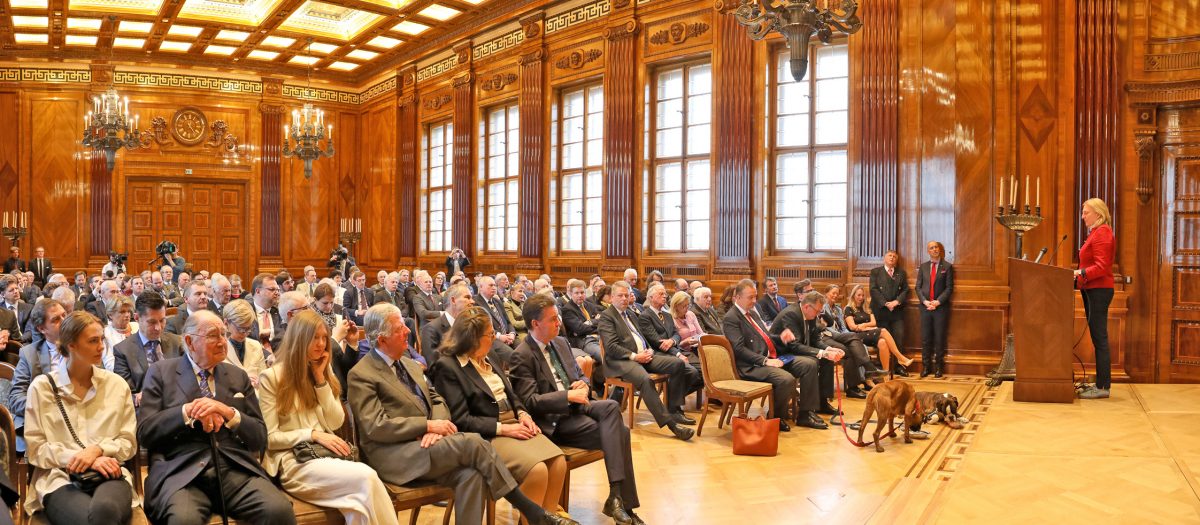
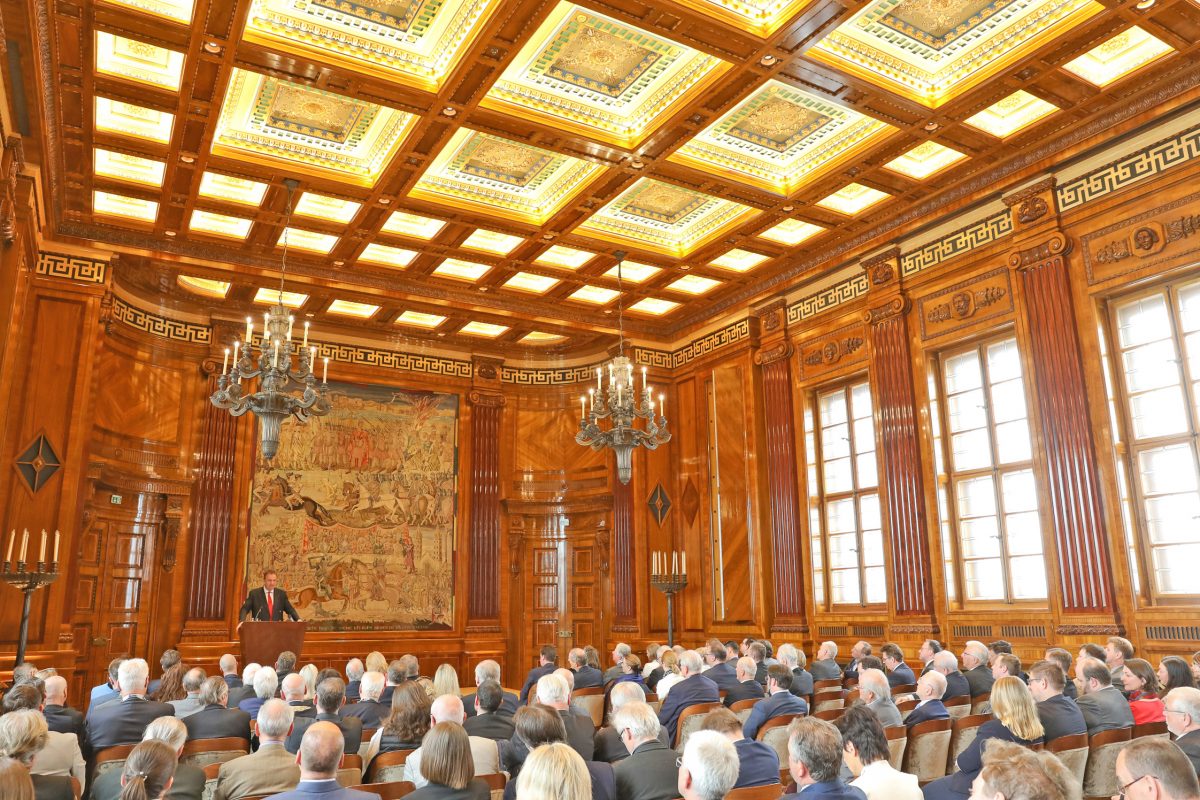
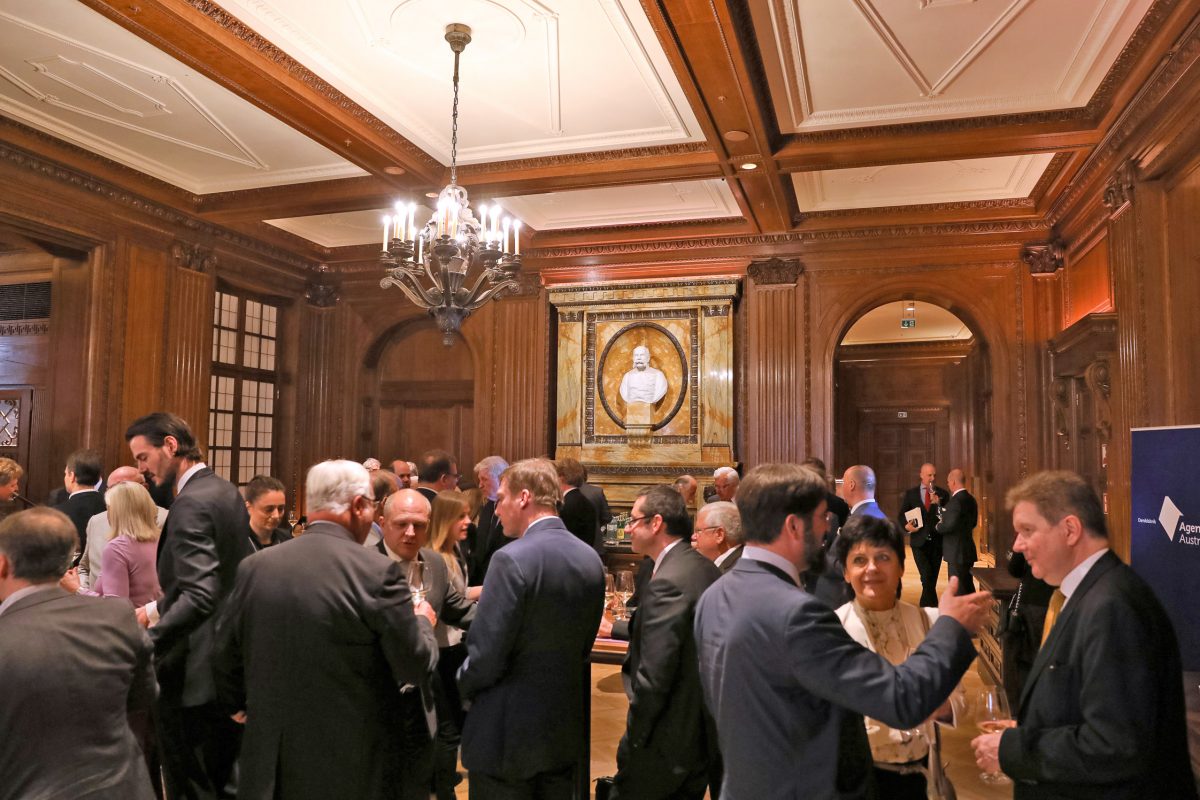
The hundredth anniversary of the end of the World War provided the occasion for Paneuropa President Karl von Habsburg, on 17 April 2018, in a “Speech on the Future of Europe”, to draw lessons from history on the one hand by reference to a number of anniversaries, and on the other to make proposals for shaping the European politics of the future. Foreign Minister Dr Karin Kneissl outlined some of the challenges for Austrian politics. A documentation of the speech by Karl von Habsburg.
Dear Foreign Minister, ladies and gentlemen, dear friends. I would like to thank you, dear Foreign Minister, especially warmly for your words. It is something absolutely refreshing when one sees that one of Austria’s most important representatives – above all in the world – places the history of Europe in its historical context. I was particularly pleased that you mentioned 1648, the Peace of Westphalia, as it were as the transition from the last effects of the High and Late Middle Ages into our own time. I always use it as an example – and I am convinced that, with your background, you can assess this extremely well – when I consider the conflict in the Middle East, extending as far as Afghanistan, which has also already been going on for 30 years, which is a religious conflict similar to the period of the Thirty Years’ War, and I wait today with great interest to see who will one day assume the role of Holland for this region. In the Thirty Years’ War, Holland was admittedly on the Protestant side religiously, but absolutely pragmatic. They saw that the war was bad, and that now it was time to try to restore peace once again through the various treaties. As with the Peace of Westphalia, I hope that in the coming years we will be able to observe a similar initiative in this incredibly problematic crisis region of the Middle East. I am immensely grateful, because I know precisely how important this historical idea, this connection to history, is for this region as well.
Naturally, today’s event has to do with the year 1918. Anniversaries and years of remembrance are always an incentive to reflect on what lessons can be drawn from history. We know that history is a teacher to whom, unfortunately, one all too seldom listens.
A teacher to whom one seldom listens
But: I mention right at the beginning, since he appeared several times in the film (as an introduction to the event, a video was shown that recounts the past 100 years through the political activities of the Habsburg family heads, note), my father Otto von Habsburg, who at almost every event, at every lecture he gave, repeatedly uttered a sentence that was almost his motto: He who does not know where he comes from does not know where he is going, because he does not know where he is. This positioning on the temporal and geographical axis was of very great importance to him. Naturally, a year of remembrance such as this one serves in particular to draw on these historical experiences in order to be able to cast a glance into the future as well.
1918 brought the downfall of the empires that were directly or indirectly connected with Europe. Four of these empires were destroyed directly as a result of the war; the British Empire continued to exist for a while, but then also began moving towards its end. On the soil of these former empires, however, a great many dictatorships and totalitarian systems arose.
2018 is dominated above all by 100 years since the end of the First World War. One could name a whole series of anniversaries ending in eight, beginning with the Peace of Westphalia in 1648, through the Revolution of 1848, or also the year 1968. This year stands not only for the invasion of the USSR in the CSSR, but for a protest movement that is still called the ’68 movement today.
Some describe these events as a revolution. In any case, this revolution devoured its children very quickly.
The ’68ers were not a freedom movement
The ’68ers, after all, set out with the claim of rebelling against the state. In fact, no generation before them entered state service as unconditionally as the ’68ers. The march through the institutions was probably one of the most bureaucratic and statist manoeuvres that history has ever seen. It was not only about the march through the institutions, but about the creation of many new bureaucratic and centralist institutions. Fifty years later, people still believe that the ’68 movement was a freedom movement. The opposite is the case. It created bureaucracy and centralism. Bureaucracy and centralism are twins that lead directly to the loss of freedom. This movement’s sympathies for tyrants such as Mao, Pol Pot or Fidel Castro and their henchmen are evident.
But there is yet another anniversary that I would like to mention, because it is of great importance to us and because it lies relatively close to today’s date: on 1 May 800 years ago, on 1 May 1218, Rudolf I was born, with whom, 60 years later at the Battle of Dürnkrut and Jedenspeigen, the history of the Habsburg Empire, and with it the history of Central Europe, began.
1918, the end of the First World War, was a historical caesura for Europe and probably also for world politics. Until then, there had been a European order. World politics was synonymous with the politics of European powers.
In 1918, what occurred was something that in 1914 none of the leading politicians of the time, regardless of which of the participating countries they belonged to, had ever included in their considerations.
1918 brought the downfall of the empires that were directly or indirectly connected with Europe. Four of these empires were destroyed directly as a result of the war; the British Empire continued to exist for a while, but then also began moving towards its end. On the soil of these former empires, however, a great many dictatorships and totalitarian systems arose.
The Central European cultural sphere was fragmented
In Central Europe, a cultural sphere that had grown over centuries was fragmented. Nationalism took the helm. But none of the new nation-states could fulfil the claim of being a nation-state. Each of the new states had its ethnic groups that belonged to a different language community.
But it was not only a cultural sphere that was fragmented, but also an economic sphere. Each individual state tried to solve its problems through isolationist policies, through protectionism and nationalism, but in reality only made them worse.
Only a few drew the lessons from the caesura of 1918. One of those who interpreted this rupture correctly was Richard Coudenhove-Kalergi, who in 1922 submitted his proposal “Paneuropa”. A Europe fragmented into small states would become a plaything of non-European powers – he named Russia and the USA – and the politics of protectionism would only increase the damage, so ran his clear analysis. Therefore, Europe had to find its way to unification, since otherwise it would plunge into another devastating war. And we know how clear his vision was back then in the 1920s, and what followed.
If one examines the roots of this success story, one will find a foundation that rests essentially on the pillars of the rule of law and freedom. To this are added further elements such as the importance of the family as the germ cell of society, which was protected by the state but not regulated. On this foundation rest further basic pillars such as private property, personal liability for failure but also for success, and thus private enterprise, which must rely on innovation in order to be successful.
It is surely no coincidence that the Paneuropa idea had its origin in Austria, where there was still an elite that thought and acted in the spirit of the supranational idea. It is surely also no coincidence that the Austrian government of the time massively supported the Paneuropa Union.
In particular, the seizure of power by the National Socialists in Germany made it clear that Austria was in a quite decisive position for the further development of Europe.
The annexation of Austria was the beginning
Only a few wanted to recognise that an annexation of Austria by Hitler’s Germany was the direct path to the Second World War. One may therefore date the beginning of the Second World War – unless one speaks of a Thirty Years’ War in the 20th century altogether, which began in 1914 and only ended in 1945 – to 12 March 1938.
Only on the ruins of this Thirty Years’ War of the 20th century did the idea of European unification have a realistic chance of being implemented. However, only in the western part of the continent, since the eastern part was locked into a Soviet prison by the Iron Curtain.
What was the idea of European unification? European unification was not begun in order to standardise taxes and turn Europe into a high-tax country that forbids non-members from being tax havens. Who, after all, would want to turn their own country into a desert? The core idea of European unification is the creation of a common zone of freedom, security and justice.
European security policy stood as the foundation at the beginning of European unification. I believe that far too little thought is often given to the fact that the basic principles of the founding fathers of the European Union were indeed to create a large security area, but that they knew precisely that at the end of the Second World War it would not be possible, given the situation at the time, to create this security area militarily and politically with Germany. That is why they knew that it would be necessary to create this area on an economic level, with the aim of allowing the political institutions and also the security policy institutions to follow. And we also know from history that in many cases this worked very well, that this approach was correct. However, we also know that this was only the case in Western Europe.
There was this belief in the outbreak of eternal security in Europe, which actually proved false as early as 1991, at the beginning of the wars of conquest of the dictator Slobodan Milošević.
The error of eternal security
Nevertheless, the capacities of the defence forces in Europe were massively reduced. Among other things, with the argument that there would be a warning time of at least ten years before new crises or even wars would occur.
One can destroy an army in a relatively short time, but rebuilding it takes decades.
Nor did any of the experts who spoke of a lead time of ten years predict the appearance of the little green men in Crimea.
Europe allowed itself to be completely taken by surprise in the refugee crisis, because all the signs were negated, and still are. Anyone who engages with studies on the subject will realise that we have so far experienced only a homeopathic dose of what may still come. I ask you only to think of the situation in Egypt. If a political change occurs there, then we suddenly have a group of five or six million Christians who will have to leave the country. And we can be sure that they will not knock on a neighbouring country’s door. They will not withdraw to Libya, but will come to Europe. And that has a completely different dimension from what we have already experienced.
But we must no longer allow ourselves to be taken by surprise.
In this matter there is only a European solution; no nation-state can solve the problem alone. Sealing oneself off behind national, small-scale borders is perhaps a short-term apparent solution, but it is not a solution. We must be clear that Europe will look different in 20 years. If we want to preserve our European culture, we must work out common solutions for this. This must be tackled in the welfare state just as much as in the protectionist policy towards Africa. There must be a clear distinction between refugees and labour migrants. But the nation-states must also overcome their egoisms for once, and in the interest of a security policy give up their blockade against a genuine European border protection.
Surveillance is not security policy
Security policy, however, is a comprehensive concept that is not to be seen only in military terms. It also includes, for example, foreign policy. Incidentally, the very widespread tendency today to intensify surveillance of citizens and deny them civil liberties does not belong to security policy. Let us think, for example, of recent proposals from Great Britain to regulate the possession of knives. That is paternalism that mature citizens do not deserve. All of you probably learned the same basic rule from your parents as I learned from mine: knife, fork, scissors, light …
We all know that. These are thoroughly sensible rules that we really ought to internalise, and therefore we certainly do not need state regulation in this respect.
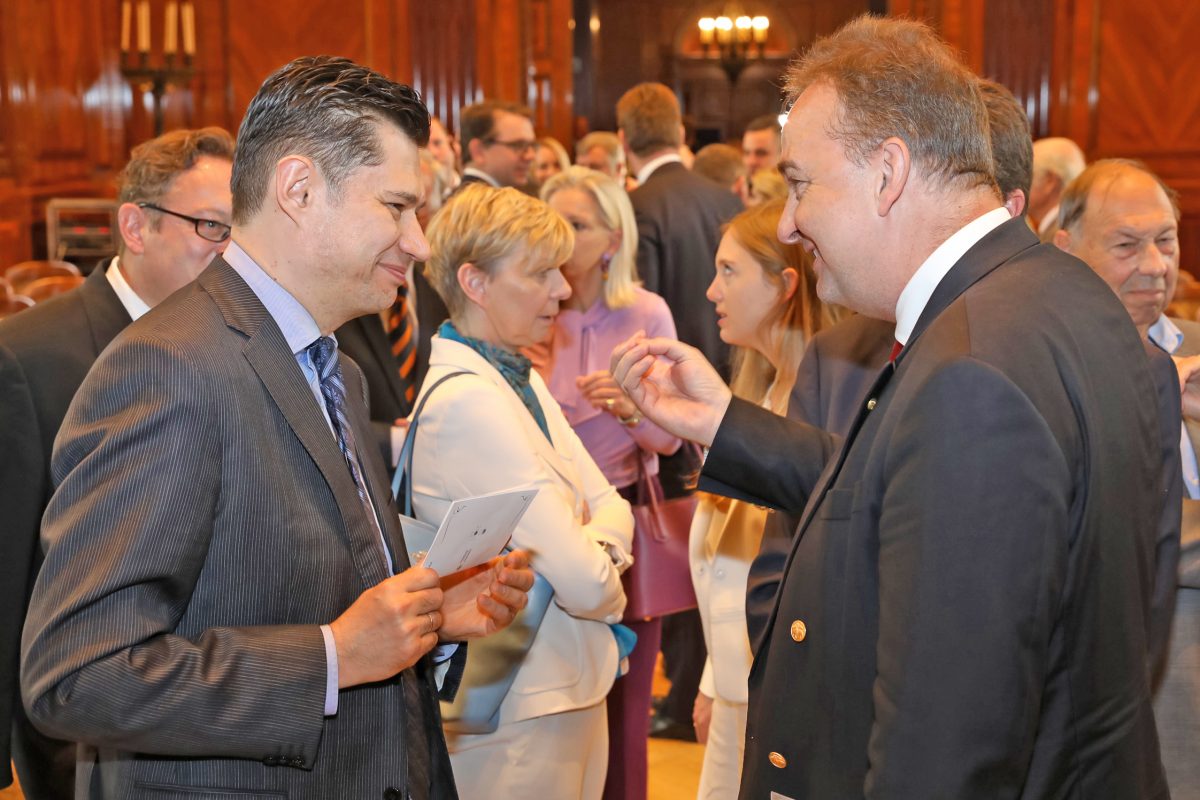
The European option is a motivation for Ukrainians to carry out reforms. They know that they are not making these reforms for the EU, but for themselves. Ukraine is currently in the neighbourhood policy, which excludes accession to the EU – it defines a neighbourhood. Therefore, our goal must be to improve this neighbourhood policy towards Ukraine into a concrete enlargement policy. Karl von Habsburg in conversation with the Ukrainian ambassador Olexander Scherba, in the background the Macedonian ambassador Vasilka Poposka Trenevska.
A concrete aspect of a European security policy is enlargement policy.
Every European country has the right to participate in European unification and thereby to aspire to accession to the European Union. Criteria must be fulfilled for this.
In saying this, I do not wish to equate Europe and the EU. Doubtless Europe is larger than today’s EU is. No reasonable person would dispute that Ukraine, Kosovo or Macedonia are European countries, even if they do not yet belong to the EU today.
Accession perspective for all European countries
But if we speak of a European Union, then this Union should also actually be European. That is, it should encompass all of Europe. To this end, it is necessary to open up an accession perspective to all European countries that do not yet belong to the European Union today.
“The further we push the borders of freedom eastwards, the safer the centre becomes.” Some of you will still remember this sentence of my father’s, which for him was one of the justifications for the EU’s eastward enlargement after the fall of the Iron Curtain.
The sentence still holds true today when we think of the eastern part of Europe and thus of Ukraine.
With their “Revolution of Dignity”, the Ukrainians made it clear that they are choosing the European option.
Viktor Yanukovych announced and promised this European path, and then took the road to Russia. The Ukrainians rose up against this.
The European option is a motivation for Ukrainians to carry out reforms. They know that they are not making these reforms for the EU, but for themselves. Ukraine is currently in the neighbourhood policy, which excludes accession to the EU – it defines a neighbourhood. Therefore, our goal must be to improve this neighbourhood policy towards Ukraine into a concrete enlargement policy.
From an Austrian perspective, it is easy to talk about these countries, since we are very close to them. If we travel the distance to the Swiss border in the other direction, we are in Ukraine. And if we travel this distance in yet another direction, then we are in South-Eastern Europe. In EU jargon, these countries are today grouped together under the term “Western Balkans”, which I find somewhat peculiar. Dear Foreign Minister, we are agreed that we speak of South-Eastern Europe!
Honour the accession promise for South-Eastern Europe
These six countries – Albania, Bosnia-Herzegovina, Kosovo, Macedonia, Montenegro and Serbia – are, as a glance at the map shows, something like a white spot surrounded by the EU. In 2003, these countries were promised accession in Thessaloniki, only for the matter to be put on the back burner. This created a vacuum into which other powers have pushed. You all know the stories of the rich Saudi Wahhabis who not only finance mosques in the region, but in Bosnia-Herzegovina in particular are buying up entire villages. The Bosnian Muslims are not at all enthusiastic about this influence, which is not compatible with the Islam as it is lived in the country. You may have heard how a few days ago the Prime Minister of Kosovo, Ramush Haradinaj, said that under Skanderbeg the Albanians had already defeated the Turks once. That was his rhetorical reaction to the very direct Turkish influence on schools in his country. And you will certainly also remember the assassination attempt carried out by the Russian secret service (and, thank God, failed) during the election campaign in Montenegro two years ago.
All three examples mentioned – and there would be many more – have direct effects on the security situation of Austria and the EU.
Politics is a dynamic process; the world is changing. If Europe does not act, other powers push into this void.
Here the objection is often raised that enlargement is too expensive, that it costs something. That is a very one-dimensional view that blanks out essential aspects. Even if one considers only the economic side and the costs, one must consider what the costs of a zone of instability – let us think of the three examples mentioned – are. The higher the democratic and rule-of-law standards are, the better it is for Europe, the more attractive it becomes to invest in the region and thereby create prosperity. The politicians of the countries of South-Eastern Europe also know that they are not making the reforms for the EU, but for their own countries.
Redistribution cannot be the goal
However, I am not a great fan of redistribution. Structural aid is good, right and important in order to help weak regions get on their feet. But it cannot be the goal to create permanently subsidised regions. That makes sense neither at the level of the member states nor at the level of the European Union.
Anyone who knows South-Eastern Europe knows that this region – and here I speak with a certain familial historical pride – places very great hopes in Austria and the Austrian Council Presidency. This also applies to Ukraine, even if today’s Austria could still make some contributions in this matter to improve its reputation.
Doubtless all these challenges must be mastered against the background of a crisis within the EU that cannot be overlooked. The causes are probably multifaceted. I would like to single out two aspects.
European unification began after the Second World War in the western part of the continent with six relatively homogeneous countries. The most important part was the cooperation between the two rivals Germany and France, which soon led to the so-called Franco-German engine of unification. Clearly, if the two great wartime adversaries of the preceding century did not cooperate, this European cooperation could not exist. In this way, agreement could also be reached with the others, mostly quite easily. The concept still worked after the first enlargements, but reached its natural limits at the latest in the course of the enlargement after the fall of the Iron Curtain.
This does not refer only to the differing views of the two countries on some important questions. A union with more than 20 members can no longer be organised with the methods used for six members.
All attempts to revive the Franco-German axis are doomed to failure. It would only mobilise counterforces. It is too deeply entrenched in the thinking of hegemonic powers.
Central Europe instead of the Franco-German axis
We should instead fill the term Central Europe with some life again. Signs of this cultural sphere are still visible. Central Europe is a key to the division of Europe into East and West, still present in many minds as a consequence of the former Iron Curtain. Central Europe is not a concept of the nation-state. On the contrary, it is based on the regions, it is based on the imperial idea, which has nothing to do with an imperium, but stands for a supranational order.
The second aspect is connected with the fact that the actual and original idea of Europe seems to have been lost in the many programmes for regulating our coexistence through state intervention. In 1918, a European order perished. So one must ask the question of what constituted this European order. How could it be that precisely this relatively small Europe could grow to this importance? Fertile landscapes, mineral resources or brave warriors were known to the other continents as well.
If one examines the roots of this success story, one will find a foundation that rests essentially on the pillars of the rule of law and freedom. To this are added further elements such as the importance of the family as the germ cell of society, which was protected by the state but not regulated. On this foundation rest further basic pillars such as private property, personal liability for failure but also for success, and thus private enterprise, which must rely on innovation in order to be successful. The combination of entrepreneurial spirit, innovative strength, personal responsibility and the rule of law is the cornerstone of prosperity. That these principles could develop in a culture that is quite clearly shaped by Christianity is no coincidence.
Rule of law and freedom
A glance at the political and economic map shows that these basic pillars of the rule of law and freedom were one of the prerequisites for the rise of other countries as well. The USA has a cultural background whose roots lie in Europe. After the Second World War, Asia gradually adopted many elements of these cultural prerequisites. In other regions, however, the rule of law, legal certainty and thus also the protection of private property are completely absent. Those are the regions of the world where there are the most problems.
Europe must be given competence where this competence – as, for example, in foreign and security policy – can develop sovereignty. At the same time, however, the sovereignty of citizens, their freedom and responsibility to be able to develop again, must be strengthened. The paternalistic welfare state is not a concept for the future. If we concentrate on making the European Union an inclusive, subsidiary state for all Europeans, then we can attain on the world political stage the importance that is Europe’s due.
This emphasis on law is so important because, precisely in Europe, calls for a primacy of politics are repeatedly heard. Politics must regulate everything. But the more it does so, the deeper the conflict with law becomes, because it is no longer rule-of-law principles that govern, but power relations. This conflict works to Europe’s detriment in the long term. Politics simply cannot regulate everything.
The Austrian Nobel laureate in economics Friedrich August von Hayek coined in his studies the distinction between inclusive and exclusive states. The supranational empires from Alexander the Great to the Habsburg Monarchy were examples of inclusive states. They tend to be more tolerant, allow more freedom, because they do not build on demarcation.
Inclusive state or exclusive state
Exclusive states, by contrast, build on clearly defined groups. The idea of the nation-state is a classic example of this. Here the tribal culture, which did not yet know a state, is raised to the level of a state. The welfare state, a political concept for making citizens dependent on the state – moreover with their own money – is a consequence of this exclusive state.
This concept has already failed; the effects of the refugee crisis were only the most recent proof of this, and the national debts that will still affect our grandchildren are an older proof of it.
The greatest problem in the perception of the European Union is that it is seen, both in the parties and among many citizens, through the eyes of the exclusive state. This concept is doomed to failure.
Overcome the idea of the nation-state
European unification can only work if we overcome the idea of the nation-state and think in terms of an inclusive state or also of the supranational order of the imperial idea.
A dismantling of the EU back to purely intergovernmental cooperation, or even a relapse into a Europe of nation-states, is not a sensible alternative given the current situation. This must be said in view of a growing number of people who shrug their shoulders and think it would not be such a pity if the EU were to fall apart again. What these shoulder-shruggers do not consider is: what comes afterwards? It is an illusion to believe that we would then live again in nation-states as in the 1960s. The world has changed enormously since then. Europe could then rather be compared with Germany at the time of Napoleon. Self-satisfied petty statehood. Until Bismarck came and created a German Reich with blood and iron. But that was not to the advantage of Germany and Europe either. The consequences are known.
In today’s world, however, it would not be a German chancellor who would assume Bismarck’s role, but rather a Russian president by the name of Vladimir Putin. Apart from European vassal states – among which Germany might perhaps still represent a small power – nothing would then remain of Europe. One should be clear about this, even if one criticises the current state of European politics quite rightly.
Anyone who looks at Europe from the outside, and does not cling to the daily conflicts of petty partisan squabbling, will see that this EU has quite modern institutions.
Centralism and bureaucratism are not inventions of the EU, after all. The member states have already managed that themselves. If I compare the European bureaucracy with the national bureaucracies, then I must come to the conclusion that the EU bureaucracy is considerably more transparent. That does not yet mean that one must agree with everything that comes out of the European Parliament and the European Commission.
The structural problem lies in the Council, which, in the logic of its composition, naturally thinks in the dimension of the nation-state.
A second chamber for the Parliament
What the European Parliament would need is a second chamber. It is logical that the European Union has an institution that represents the member states, similar to our Bundesrat. Ideally, however, a second chamber acts independently of day-to-day politics, and is thus an instrument against ad hoc legislation.
Ladies and Gentlemen,
If we span the arc from 1918 to 2018, then we see quite clearly where the points of reference are for drawing lessons from the historical development, from history. We live today in a European Union that naturally has its faults and weaknesses. But despite all these faults and weaknesses, it is exemplary in many respects.
But it must be improved again and again, for example with a reform of the Council and a second chamber. To express it with Lampedusa in the classic “Il Gattopardo”: something must change so that it stays as it is!
We must be clear that we need a united Europe in order to master challenges such as the security situation or the migration crisis.
Europe must be given competence where this competence – as, for example, in foreign and security policy – can develop sovereignty. At the same time, however, the sovereignty of citizens, their freedom and responsibility to be able to develop again, must be strengthened. The paternalistic welfare state is not a concept for the future. If we concentrate on making the European Union an inclusive, subsidiary state for all Europeans, then we can attain on the world political stage the importance that is Europe’s due. If we make the European Union a zone of freedom, security and justice, then our future grandchildren will also look back on the year 2018 and say: back then they began to make Europe fit for the future.
Photos: Katharina Schiffl
