A Century Later – The Same Question
In 1926, Richard Coudenhove-Kalergi held the first Paneuropean Congress in Vienna to promote an idea most of his contemporaries regarded as utopian: a united Europe. A hundred years later, at the start of October, the Paneuropean movement returned to our city and adopted the Vienna Declaration for a Strong Europe; I was glad to join.
The Declaration does not restate the founders’ arguments for unification, since those arguments have already been settled. As the text states, the Council of Europe and the European Union are established and proven frameworks, comprising genuine European institutions and competences. The Declaration then poses a more difficult question: what is Europe for and is it able to defend what it has achieved?
No better time could possibly be chosen. Europe has lost the arrangements that kept it at ease for three decades. Cheap energy from Russia and discounted American security guarantees are gone, and they won’t return on old terms. A full-scale war currently underway along its eastern frontier has undermined the belief that borders on this continent would never change by force. Hybrid pressure is also affecting its member states, and enlargement, long regarded as a slow technical process, has once again become a strategic issue. The Declaration addresses this very situation.
In this article, I aim to do three things: explain why I believe the Declaration’s main argument is correct, offer a few modest thoughts on how some of its ideas might be developed further, and suggest what is necessary to turn the document into policy.
The Right Diagnosis: From Integration to Geopolitics
The Declaration’s main assertion is simple and, as I see it, accurate: Europe has developed impressive institutions, but it still lacks the geopolitical approach on which the Paneuropean movement was based. While the Union is skilled at regulating a market, negotiating trade agreements, and managing a common currency, it is far less experienced at thinking in terms of power, deterrence, and strategic interests.
This issue is not merely theoretical. For many years, the Union regarded its eastern neighbourhood as a region it could manage through programmes and progress reports. Moscow, by contrast, saw the same region as a domain for competition. The consequences can be seen in the territories that have been occupied in Georgia, Moldova and Ukraine, as well as in the war which has altered Europe’s security map.
The Declaration answers this with a clear ambition: a European foreign, security and defence policy worthy of the name, with its own ministers, its own resources and democratic accountability through the European Parliament. One may debate the institutional design, and I will, but the direction is right. A Union that cannot act together in foreign and security policy will remain an object of other powers’ strategies rather than a subject of its own.
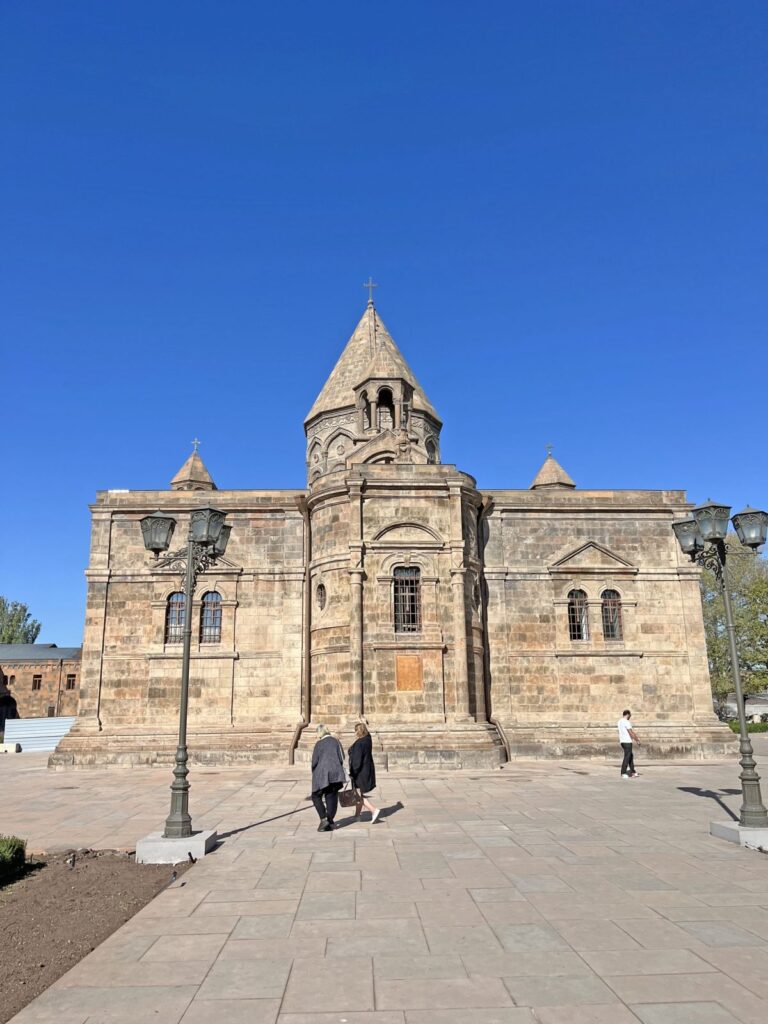
The macro-region of Armenia, Georgia, Moldova, Ukraine will be decisive for the future relationship between Europe and today’s Russia.
It is just as valid to base this aim on values rather than on power for its own sake; peace, freedom, the rule of law, democracy and the market economy are given as the objectives of a European foreign policy, not just as decorative features. This matters; a European foreign policy that forgets its reason for existence would soon lose the trust of its own citizens, as well as the societies to its east that look to it.
Enlargement as a Security Instrument
The Declaration’s most convincing aspect is its approach to enlargement. It includes a quote from Otto von Habsburg: “the more we extend the borders of freedom to the east, the safer the centre will become”.
This statement shows exactly what Brussels failed to realise. Enlargement is not a reward for good behaviour; it is one of Europe’s most effective security measures.
The Declaration goes beyond the usual content of official documents by calling for a clear European strategy for the macro-region that includes Ukraine, Moldova, Georgia, and Armenia, namely, integrating these countries into the European community of values and guaranteeing their safety from threats from Moscow. This is a major proposal. Although these four countries are usually dealt with separately, each pursuing its own path and timetable, they face the same enemy, the same pressures, and the same question: can they determine their own future without incurring punishment for doing so?
Georgia has shown that the security aspect cannot be ignored. The EU gave this country candidate status in December 2023. Just under a year later, in November 2024, its government put the accession process on hold. Russia didn’t have to start a new war to achieve this. What it could not accomplish with tanks in 2008, it has instead pursued through cognitive and political warfare, networks of influence, and the gradual destruction of trust in Europe. An enlargement policy which ignores such pressure will continue to lose ground it has already gained.
It is also right for the Declaration to emphasise certain conditions: respect for European values, the Copenhagen criteria, the full acquis, and sound public finances must remain prerequisites. This does not contradict the geopolitical argument but is, in fact, the foundation on which that argument rests. Granting membership without reform would introduce fragility into the Union, and pursuing reform without a realistic chance of membership would undermine its political motivation. The objective is to maintain both.
Some Benevolent Remarks
A declaration meant to guide a movement for years invites discussion, and I believe its authors would welcome it. In that spirit, let me share three reflections on how we might carry forward some of its ideas.
Regarding our views on Russia’s future, I fully agree with the Declaration that a sustainable European order will depend on the kind of country Russia becomes, and that a democratic, non-imperialist Russia would be an appropriate neighbour. To achieve this aim, we should stress what Europe can do: ensure that acts of imperialist aggression fail, support democratic elements in Russia, and make any resumption of normal relations contingent on real changes in Moscow. Framing the message this way makes it harder for Kremlin propaganda to portray it as Western hostility, both in Russia and in other countries where such a narrative is actively encouraged. The Declaration’s adherence to the UN principle of non-intervention aligns with this approach.
Second, the path to a common foreign and defence policy. The vision of a European Foreign Minister and Defence Minister, accountable to the European Parliament, is inspiring. Since this would require treaty change, it may help to pair it with steps that can already be taken within the existing treaties. Each step would bring the larger goal closer and sustain the momentum.
Thirdly, the choice of words. The Declaration should caution against Russia, Iran, and China working together against Europe, but definite labels can divert attention from a solid argument. More people will be convinced by clear, calm language, particularly in countries where Moscow’s propaganda searches for any expression it can use to turn against Europe.
This is the view of someone who shares the aim set out in the Declaration; the movement that has advocated for Europe for a hundred years has always developed through such discussions.
From Declaration to Implementation
Declarations must lead to changes in government and institutional action. Here is what I think is necessary to turn the Vienna Declaration from words into policy.
1.Take joint action at once under the present treaties; by making greater use of qualified majority voting in the field of foreign policy, through the bridging clause which the treaties already include, a single capital will no longer be able to block common positions. Steps in this direction include giving the High Representative a stronger mandate, carrying out joint defence procurement and providing common financing for defence projects, all of which are the sorts of measures envisaged by the Declaration regarding the European Foreign and Defence Ministers.
2. The eastern macro-region should have its own strategy; Ukraine, Moldova, Georgia and Armenia should have a single EU strategy which links together accession, security and resilience and includes a specific political leader to steer it. The accession process should incorporate security assistance, the protection of critical infrastructure, and aid in countering hybrid threats, not leave them for later.
3. The process of integration should be gradual and visible. Candidates already have some access to the single market and to EU programmes. This access should grow step by step as they meet the conditions, well before full membership. People should experience the advantages of choosing Europe well before the final treaty is signed. This is the best way of responding to the idea that Europe promises a lot but delivers little.
4. It is necessary to regard information warfare as a security threat. Countering foreign information manipulation and interference must be part of both enlargement and neighbourhood policy. This means supporting independent media, investing in social resilience, and ensuring consequences apply to those who carry out influence operations. Georgia illustrates what happens when this aspect is ignored. We don’t need another example.
5. Do not leave societies behind when governments turn their backs on Europe. If a government moves away from the European path, Europe should still keep its doors open to individuals via civil society, students, independent journalists and local communities. The conditions should apply to governments, not to people who still believe in Europe.
6. Bring the Ukraine measures into law. Since the Declaration calls for using frozen Russian assets to support Ukraine’s reconstruction and secure reparations, member states and their partners must agree on a solid legal framework. Because restoring Ukraine’s territorial integrity is regarded as Europe’s aim, military and financial support should continue for as long as necessary.
7. Ensure that the Declaration remains active. Paneuropa and its partners should turn the document into a dynamic agenda by conducting an annual review of progress, contributing to EU consultations, and holding dialogue with parliamentarians in Brussels and national capitals. A declaration examined each year is harder to forget.
Europe has not finished building itself
The Pan-European idea a hundred years ago was ahead of its time, but the Vienna Declaration is exactly on time today. Its main point is that Europe needs to learn to think and act geopolitically, that expansion to the east is as much a matter of security as of values, and that Ukraine’s struggle is also Europe’s struggle. This message should enjoy broad support.
My focus is on developing its ideas rather than on its object.
The test the Declaration will face will not be the number of people who signed it in Vienna; it will be whether, in the coming years, Europe provides the security and opportunities that the countries on its eastern border need to decide their own future.
Europe still has to complete its development. The Vienna Declaration reminds us that the next chapter will be written in the east.